
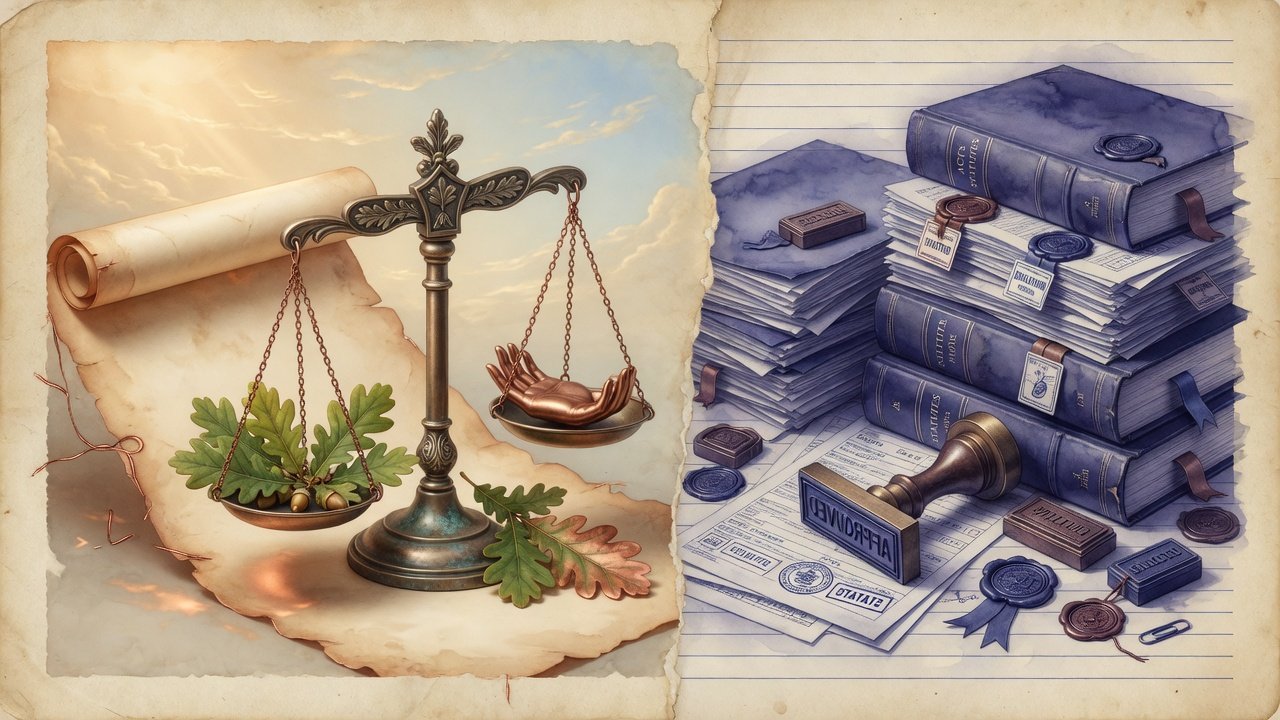
Educational only. This long-form study rewrites source teaching on the difference between law and legislation in unique prose. It is not legal advice, not a call to break any rule, and not a substitute for your own verification. Meanings are preserved; wording is original. Laws and procedures vary by place.
One side of this distinction is fact. The other is often sold as fact while remaining something else entirely. Every Act of Parliament is a statute—also called legislation, or the product of a legislative “legal law society.” In substance those instruments are regulations or rules. They are not the law of living people.
Trained barristers and solicitors still call statutes “laws” far too often. They have a duty to know better. A classic reading (associated with Halsbury) describes a statute as a legislative rule of a society given the force of law by the consent of the governed. That formula already admits the truth: the instrument is a rule, and any “force of law” it claims rides on consent—not on nature, not on automatic power over the living. Statutes are distinguishable from law in the sense of common law. The distinction is intentional. Statutes and laws are different things, for different purposes.
If Acts of Parliament were laws, they would be titled Laws of Parliament. Parliament knows the difference and keeps it. Open almost any Act: you will not find common law written as if the Act itself were that law. That absence is your first clue.
Those “in the know” keep the statute/law split because it is useful to them. A statute is defined as a rule or regulation of a society—an edict of legislative legal society used to govern that society. It is not the equal law of the land for living men and women.
Consent is individual, not collective
Every statute is subject to the consent of the society—and that consent is individual, not a majority stamp on your forehead. Belonging to a political society is a matter of choice. You may choose not to. The core distinction is simple:
- Law applies equally to all.
- Statutes can be written to favour one sector of society over another.
Preferential parking for people with disabilities is one familiar example of a statute privilege many regard as fair. Special expense dispensations politicians have written for themselves—which ordinary people do not receive—are an example many regard as outrageous. Inside government and government-run sectors, people in office sometimes commit wrongs while claiming they “must obey the law,” then impose the same claim on the public with threats and the removal of privileges as punishment. That is not the equal peace of common law; that is policy enforced as if it were nature.
There is a compulsion to obey laws in the common-law sense. There is no such natural compulsion toward a legislation society’s rule book. Common law defends freedoms and liberties so neighbours can live in peace. Failure to respect the law of the land can leave a person outside its protection—an outlaw in the old sense. Statutes, by contrast, are obeyed voluntarily—with each person’s consent. Any individual may withdraw consent to being governed (controlled) by government legislative statutes. That choice may mean exclusion from certain society benefits—only if the man or woman never paid into those systems. If years of taxes and service were paid in, government is then obligated to return what is due. When the burdens outweigh the benefits, some conclude the price of exit is worth paying. The choice remains the individual’s alone.
Consent must come from the individual—not from a collective “on behalf of” the individual. Majority rule without individual consent is dictatorship by majority. There is no freedom in having to do whatever one is told. Each living man or woman must retain the absolute right to give or withhold consent. That is the basis of constitutional order in this study’s framing.
If services are forced on a person against will or without proper standing, government is again obliged to make good—pay back and compensate in full. People are elected into office, not into raw “power” as the phrase is often abused. Everyone working in a government building sits in office and comes under the standards of public life. Breaking those standards is a common-law offence for which anyone can be held to account.
Authority, power, and the withdrawal of consent
The ultimate check on abuse of office is the people’s ability to withdraw consent to being governed—at any time, not only at elections. Without consent, enforced “authority” becomes mere power, and government becomes tyrannical. In this educational framing, forced taking without right is treated as a grave criminal wrong. People who hand authority to known liars and spin operations do not, properly speaking, hand over unlimited “power.” They grant authority to act on their behalf, with duty, obligation, and responsibility to serve and protect man and property—and no more than that.
Those in office can properly control only those who work for government and the commercial side of the system. When governing bodies ignore consent and grab power for themselves and their helpers, they drift toward tyranny. Those who place themselves above the law are outlaws and criminals in this framing, and justice requires trial by jury—not closed administrative process alone. All such questions belong before a jury: the means by which abuse of office is checked.
Rejecting statutes is not rejecting the law. Rejecting statutes is a rejection of a particular form of governance. The distinction between laws and statutes has been blurred on purpose. Many long-serving “legal” practitioners insist statutes are laws—but if they were, they would be described as such to avoid ambiguity.
Why the legal profession blurs the line
The legal profession has failed in duty, obligation, and responsibility to keep and teach the difference between laws and statutes—partly through ignorance, partly because ignorance enlarges professional authority. Why would a guild promote a distinction that shrinks its monopoly?
It is not in that profession’s interest to clarify the split. The same society now largely runs the legal court system. Magistrates (once closer to the people’s representatives) were pushed aside by statute—for example instruments such as the Magistrates’ Courts Act 1980 in the UK framing of this study—making magistrates subservient to legislative-society advisers in court. That is a power-grab statute in this educational reading.
Statutes do not apply equally. Preferential pensions for politicians, agricultural policies that reward wealthy landowners more than tenants or working farmers, police parking on double yellow lines while the public is punished for the same act, and banking privileges are familiar examples of sector favour. Special interests often benefit; banks are a notable case. Politicians leaving office are frequently rewarded with salaries, director fees, and perks—sometimes described as thanks for preferential legislation. A large number of former ministers later work for banks. If a statute transfers public authority outward (for example toward an external bureaucracy), the same pattern of consent and accountability still applies.
It has become habit to call statutes “laws.” Habits, however entrenched, do not create facts. Statutes are not laws. Those who enforce them as if they were the living law of the people should answer for that act. Statutes are supposed to protect society and support fair governance; over centuries they can mutate into instruments that oppress the wider community and benefit only narrow circles—who then defend their privileges hard.
What statutes are—and what they are not
Statutes refer to Acts of Parliament and legal legislation. They often do not protect; they are used to keep control. They can be punitive, unfair, unreasonably prescriptive, and authoritarian. We are all equal in the eyes of the law (common law). Those outside that law are classed as outlaws or criminals. We are not all equal in the eyes of legislative legal statutes.
Law (common law)
Always just in principle; protects rights and freedoms; based on principles; evolves slowly and endures; keeps the peace; without it, anarchy; made by the people through jury acceptance; nobody is above it; applies equally to all.
Statutes (legislation)
Based on practicalities (not always fairly assessed); come and go on a whim; can favour sectors; legal/illegal language of the legislation society; Parliament makes legislation for public servants and the commercial side—not the living law of the people.
| Legislation / statutes | The law (common law) |
|---|---|
| Rules & regulations of a societyActs, bills, edicts of legislation | Living measure of rightConscience, custom, jury validation |
| Force claimed by consent of the governedIndividual consent—not majority stamp alone | Applies equally to allNobody is above the law |
| Can favour one sector over anotherPrivileges, exemptions, special interests | Protects rights and freedomsPeace among neighbours |
| Obedience is voluntaryConsent may be withdrawn | Compulsion of conscience & communityOutlawry if you renounce the law itself |
| Legal / illegalLanguage of legislation society | Lawful / unlawfulLanguage of the law of the land |
| Parliament does not make the lawIt makes legislation for servants & commerce | The people make the lawBy acceptance or rejection via jury |
| Judges interpret legislationKeep records; do not author living law | Jury decides justiceIndependent of the judge’s will |
| Based on practicalitiesOften temporary, political, mutable | Based on principlesSlow to evolve; long endurance |
| De facto administrationPolicy, codes, revenue process | De jure law of the landCourt of record and peers |
Legal is not the same as lawful — legislation is not the same as law
Laws may be reflected in statutes, but if a statute is repealed, the underlying common law can remain in force. Lawful and unlawful refer to the law. Legal and illegal refer to legislation society. Without law we have anarchy. Our constitution is the foundation of our law—yet much of the legal profession is barely taught it.
Courts, judges, and juries
If Parliament passes a statute and a man charged with breaking that rule is found not guilty by a jury, that statute is effectively struck down for that purpose. A jury is not beholden to the system. A judge is. A jury is therefore more reliable than a single judge in delivering justice. Judges can be bought, blackmailed, or intimidated; corrupting a whole jury is harder.
Our jury system is protected by constitution. It is our right to be tried by a jury. The jury shields us from arbitrary power and from bent or deceitful judging. Statutes must sit in harmony with common law to be enforceable in this framing. If unfair statutes are pursued, a defendant may insist on jury trial; peers who see the injustice—and the risk of becoming its next victim—may find not guilty and thereby nullify the statute’s force in that case. That is the power of a jury. Power belongs to the people; every claimed power is derived from them.
If a matter has not been judged in a court de jure, it is nothing more than hearsay in law. Lower administrative courts operating de facto are described in classic commentary (including lines associated with Halsbury) as lacking true authority: no administrative court has any authority in the country, and no government act can be found to legitimise them under the constitutional restraints of coronation oath; collecting revenue by such means is extortion, long reprehended.
Common law trumps statutes. It is that simple in anything and in all things. Some in the legal profession argue the contrary. Common sense still says common law is and must be superior.
If a government passed legislation making itself permanent—declaring a dictatorship—the jury remains the highest authority in the land beneath the law. A jury may stand in judgement of anybody; nobody is above the law. If government makes legislation a jury finds unjust, a not-guilty verdict demonstrates the jury’s authority over government.
A judge must not direct a jury to a verdict. Many try; in so doing they breach the law. A judge may give direction on the interpretation of common law, but the jury is entirely independent. The people make the law through validation or rejection of statutes. Juries re-validate or set aside old laws through verdicts. They are the people’s protection against the arbitrary power of a ruling class. Jury trial is a common-law right protected by constitution—it cannot lawfully be stripped by government, police, judges, or solicitors. Meddling with it is unlawful. Removing jury trials is unlawful and unconstitutional.
Those who seek more power for themselves often work to dismantle jury process. That is a political power grab and must be challenged. Magistrates’ courts, in this educational framing, are statute courts with no standing in common law when they ignore common-law rights. Magistrates and judges rule on their reading of statutes; juries give verdicts on justice and are more often fair. Magistrates trained only to follow a legal adviser in court lose real autonomy. Closure of local courts and delivery of “justice” by post—penalty charge notices and similar—moves process further from peer judgement.
Penalty notices, office, and who owns the courts
Penalty charge notices (PCNs) and similar may be “legal” under statute yet not lawful under the law of the land. They are not enforced without consent in this framing. Law associated with the Petition of Right and Declaration of Rights forbids fines and forfeiture without justice in a constitutionally convened court of law with a jury of twelve. A ruling that a PCN “is not a fine” may serve other interests. Autonomy and full discretion should return to magistrates; legal advisers should again sit under magisterial authority; PCNs as instruments of oppression should be abandoned.
If a defendant claims common-law (or unalienable) rights in court, the matter becomes a common-law court for that purpose. Courts belong to the people—not to ushers, private security, magistrates, legal advisers, or circuit judges who may have forgotten—or never learned—that fact.
The monarch represents the power of the people; without the people a king or queen is only a dreamer. The public took an oath under common law (not under “the Government”) in the courts of the people. Courts do not draw authority from government. Magistrates and judges give allegiance to the Crown; without that allegiance they have no authority. If the Crown breaks the oath of the people and its laws, authority reverts to the people to rebuild communities and societies as they lawfully choose. Neither judge, nor legal adviser, nor government, nor monarch may dictate to the people whom they may choose as representatives.
The “right of audience” claimed by the legal profession in court is, in this study, a statute imposed without the people’s common-law authorship—a closed fraternity some call a protection racket. Courts exist to serve justice, not to extract money and free labour. Pushing people into unpaid forced process is treated here as a criminal wrong for those who knowingly drive it. Automatic appeal from a magistrates’ court to a higher court where jury trial may be available is a safety valve—but jury trial should be available on the merits of living cases from the start. Withholding a jury trial is unlawful: a deliberate power grab and an attempt to subvert common law into statutes—the thin end of a thick wedge in which legislation society would become judge, jury, and executioner toward the people.
Claiming common-law jurisdiction
When common-law jurisdiction is claimed in court, statutes cannot be imposed without the defendant’s consent. You do not need permission to claim common-law rights; they are innate. Denying common-law rights in court is contempt of court—including when a judge does it. Consent can be withheld, and with it the assumption that others hold authority over you.
If the political establishment refuses to acknowledge constitution and the rule of law (common law), that refusal does not erase them. If they ignore constitution and the rule of law, you have both a right and a duty, in this framing, to ignore their statutes of legislation society.
Governments do not make law, nor can they change, amend, or remove living law. They make and change legislation for public servants—the only domain they are allowed to control—not the people. Governments are not above the law (though they often act as if they were). They can exempt themselves from their own statutes—and because they sit above those statutes (as anyone may refuse the voluntary rule book), they begin to assume they are also above the law. They are not.
The truth is the truth even if no one believes it. A lie is a lie even if everyone believes it.
What “statute” actually means
The familiar line again: “A legislative rule of society given the force of law by consent of the governed.” That is the commonly used definition of “statute.” Notice: it never says the rule is the law. It is a rule given force by consent. Most of us live under many such rules and Acts—yet the definition itself calls them rules, not law.
Rules are made to be questioned. The more rules one breaks in a revenue system, the more one is often made to pay—another clue that the system is commercial process, not peer justice alone.
Sourced definitions of “statute” include: an act of the legislature as an organized body (Washington v. Dowling, 92 Fla. 601); the written will of the legislative department expressed in the form necessary to constitute it a law of the state and authenticated by prescribed solemnities. In a broader sense (Ballantine and related digests): an act of the legislature, an administrative regulation, or an enactment from whatever source, to which the state gives the force of law. An “act” is a thing done or established—a deed or written instrument evidencing a contract or obligation. A statute is a bill enacted by the legislature into a law, as distinguished from a bill still only proposed. “Legislature,” broadly, is anybody having legislative power. “Regulation” is control or direction by restriction or rule—public or private—whether by statute, ordinance, or resolution. “State” is a body politic or society of men united for mutual safety and advantage, occupying a defined territory, organized under one government—and, in classic language, a political community of free citizens established by the consent of the governed and limited by a written constitution.
| Piece | Meaning in this study |
|---|---|
| Act of the legislature | Legislative product — a rule |
| Administrative regulation | A rule of control or direction |
| State | Political community by consent of the governed |
| “Force of law” | Claimed force — rides on consent, not nature |
| Common law | Living law of the land — superior in principle |
Connect the dots: a legislative rule given force only by consent — not the law itself
Put together: an act of the legislature equals a legislative product; an administrative regulation equals a rule; the state equals a political community organized under government and established by consent of the governed. In the broad sense, the state gives “force of law” to legislative and administrative rules. Connect those dots and you recover the Halsbury-style line: a legislative rule given the force of law by the political community established by the consent of the governed. Knowing who they are helps you realise who you are—and who holds the power.
How to hold the distinction in practice
Study, do not panic. When presentments arrive dressed as “the law,” ask which sense is meant: living common law of equal peers, or legislation for persons, franchises, and commerce. Challenge jurisdiction. Demand an injured party where crime is alleged. Insist that legal and lawful are not synonyms. Related reading on this site:
- The Law vs Statutes — short side-by-side overview
- Jurisdiction Is the Key — capacity, consent, venue
- The Courts and Administrative Courts
- Your Consent and Rebut the Presumption
- The Burden of Proof and Public Servants
Educate yourself. Ask questions. Verify everything. Rejecting a statute is not rejecting the law of the land. Keeping that one sentence clear is half the work of standing free in the private.