
Educational research summary only. This page is not legal advice. It rewrites, for study, themes long circulated under the heading “Justinian Deception / Dog-Latin.” Verify every claim, style manual, and statute yourself. Laws and procedures vary by place.
This article gathers years of research that began with three practical questions put to a Queensland magistrate about the validity of a driver’s licence (and, by extension, many other governmental instruments). The questions were:
- Why does the name appear “back to front,” with the family name first?
- What is the all-uppercase text—because it does not appear to be correct English under ordinary style manuals such as the Oxford English styles tradition?
- Which style manual was used to construct the licence with the name in all-uppercase text?
Those questions produced an estoppel-like silence in court: the magistrate would not answer, and officers were warned not to touch the living man again. The research that followed asked why magistrates could not answer—and what grammatical standing, or lack of it, might underlie international commercial (maritime) governance over common-law birthright on the land.
What emerged is a disturbing account of a grammatical system that may be centuries old—linked in this literature to Justinian’s era (roughly 530–560 AD)—and even compared to ancient systems of slavery and symbolism. The claim is not that every reader must accept every historical parallel, but that two languages on one instrument create a jurisdictional problem the unaware never see.
Dog-Latin: the poison in the text
Dog-Latin (also written DOG-LATIN) is described as the poison in the gloss—the debased form that corrupts the essence of the text. There is, on this view, no jurisdiction between two separate languages appearing on one document. English descriptive prose and Dog-Latin cannot lawfully operate as one without agreement. That dual presence is treated as the core of the deceptive structure.
Dog-Latin is called the language of the illiterate: Latin-style ALL-UPPERCASE text pushed into English descriptive writing, yet not under the true grammatical rules of classical Latin. It is said to appear under English layout rules as all-uppercase symbolic text without the hyphens that correct sign-language Latin would use—so as to deceive the ignorant masses.
In that framing, Dog-Latin destroys the dominion of living man over land, sky, sea, and “the thing that creeps”—often identified with the SURNAME (Genesis 1:26 is cited as the dominion grant). Dog-Latin is called the Babylonian language of the vassal: third party, debtor of the debtor—“vassal of the vessel.” It is found on the ledger (compared to tombstones). Attachment to it is treated as a presumption of conformation—a “sign” that you have sinned—so that you no longer serve the God of living man but the god of the corporation: debtor of the debtor. Person and corporation, in this education, exist only in the water-world of the dead; they have no place on land with living man.
| Descriptive English | Dog-Latin / all-caps signs |
|---|---|
| Proper names capitalised | Names symbolised in ALL CAPS |
| Words joined by spaces under English rules | Signs need hyphens; spaces stop the chain |
| Living / land / common law frame | Dead ledger / maritime / corporate frame |
| Readable sentence meaning | Debased, unreadable as Latin or English |
Two grammatical rule-sets — confusion is the trap
Corporations are pictured as ships in dry dock; their Dog-Latin is treated as fraud against the living man. A man cannot live in the sea without a ship; if he enters the legal world of commerce (maritime jurisdiction), he must trust the ship that holds his estate. If that ship is “dogged” with corruption, the cargo—the estate—is in peril.

Power of Rome in modern governance
The literature asks whether modern systems that govern “citizens” still carry the power of Rome—and whether that power is just. The answer offered is sobering: control depends on hidden grammatical rules of a foreign language usurped into English without the common man noticing.
London or Rome? The question is only answered, it is said, by comprehending English rules versus foreign Latin used as the official written language of Roman debtor accounts—the language of the debtor. Is the City of London truly “England,” or a continuation of Roman imperial accounting? Ancient all-uppercase Latin is treated as copyright property of the Vatican / Roman system; use of it is said to attach the user to Roman terms—you “need a licence to use it.”
But is everyday all-caps text on licences, court papers, and bank forms true Latin—or a dogged corruption that is neither true English nor correct Latin? If “This written text is English” and “THIS-IS-PROPER-SYMBOLIC-SIGN-LANGUAGE-LATIN,” then what is unhyphenated “THIS TEXT,” and who benefits from the blind eye?
If you hold accounts “glossed” into ancient Latin style—forms such as JOHN PAUL SMITH, John Paul SMITH, or MR SMITH—on passport, licence, bank account, and more, the question is whether you have become third-party title holder of Rome: debtor of Rome. A true name, grammatically, is capitalised, not symbolised. Illustrative text is a picture, not writing. Ignorance of English and Latin grammar is treated as the root of mistaking a foreign debtor designation for your true name.
Christian name and surname: two, not one
Even ordinary naming is presented as two entities: Christian (given) name and SURNAME—two, not one—sometimes linked to two birthing certificates: birth of the Christian-name account and birth of the surname account. The full legal person (given name + surname in ordinary English, e.g. John Paul Smith) is said to be completed at registration, not on the biological born date. The true full living name is only the given name; the State joins the family name, so the State is argued to be liable for debts of its own copyrighted construction.
Why was Latin and grammar removed from corporate state schooling? So that people cannot read the deception in plain sight. Born into fraud and living in it, facing the truth is hard; many refuse to accept that lack of grammar knowledge caused misunderstanding of their own name. The surname is assumed; it is not your property and does not appear as part of your living name on the certificate in the way people assume.
Who was Justinian?
Justinian was Emperor of Rome from 527 AD to 565 AD. In this educational narrative he understood “God” as Grantor Of Dominion (G-O-D)—Article / Genesis 1:26 as authorisation of total authority over the world to man: land, sky, sea, and the thing that creeps. Without that grant, man would have no legal ability to govern anything. The same statute is read as preventing governance over man, because man holds the highest authority—including over the creeping thing, interpreted as the legal dead SURNAME that “creeps up from below.”
Only living man holds sovereignty / dominion over natural mineral and energy wealth of Eden (Earth). Therefore man must be assumed dead-in-the-water before a usurper can claim equitable title over Eden. The serpent (usurper) only holds authority over its own property—the dead accounts, the persons of Rome. A person is not a living man; it is a rank, a military account-holder. By agreeing to hold any form of account, one agrees to serve the second god—the god of the person, the pagan “pay-again,” the world debtor, legal title holder of Eden. Holding Roman accounts is cast as serving the beast of burden.
Trust-law: master–servant by consent
Trust-law is presented as the legal code of a master–servant relationship—slavery in substance. Open slavery is outlawed, but voluntary servitude is legally accepted: the servant must agree or consent to a private contract of slavery. No one in their right mind wants to be a slave; hence biblical warnings against the serpent’s deception in Eden. Through clever deception, trust-law becomes the new slavery, perfected over centuries by legal minds of deceit—the Justinian deception (Vatican frame).
All that is required is that living man give consent to a dead corporation so the corporation can access dominion. If he does not consent, a secret system of deception may obtain consent without awareness. That secret system, this research claims, exists.
What Justinian is said to have done
He created a concept of deception that “killed man” legally without anyone knowing they were legally dead—sacrificed at birth, dumped into the sea of commercial paper, to be salvaged by the Roman system before they knew they were assumed lost at sea. Between roughly 530 and 560 AD, Justinian and his legal team are credited with a governmental masterpiece: deceiving the public into private military contracts of the Roman Empire under Vatican control, so as to forgo true justice.
Justice is a straight line; Dog-Latin bends the line—corruption, spurious document, declension, debasement, immoral act that no positive law could follow. People assumed the text was English and “corrected” the error in the name—when it was never their name in the first place. The deception was under the nose in plain sight.
Translations: English, Dog-Latin, and true Latin
Black’s Law Dictionary is cited for Dog-Latin as a debased form of Latin appearing under English grammatical rules—unreadable. Example shape: “IT SIMPLY LOOKS LIKE THIS.” Where? Court documents, government paper, banking paper, driver’s licences—the entities people assumed they could trust. It exists only with the consent of the ignorant; it is the language of the illiterate.
Sample chain:
- English: “The cat sat on the mat”
- Proper symbolic Latin / sign style (hyphenated): “THE-CAT-SAT-ON-THE-MAT”
- Dog-Latin (all caps, spaces, no hyphens): “THE CAT SAT ON THE MAT” → read as “The. Cat. Sat. On. The. Mat.” — nonsense as a sentence in either system
That second all-caps form is Dog-Latin: debased, declension, wrong, immoral, void. It is also the language of the dead ledger—linked symbolically to Anubis (dog-headed god of the underworld) and related Egyptian death symbolism (Eye of Horus on currency notes, and so on). The question is asked whether this is a revival of Egyptian-style slavery through grammar.
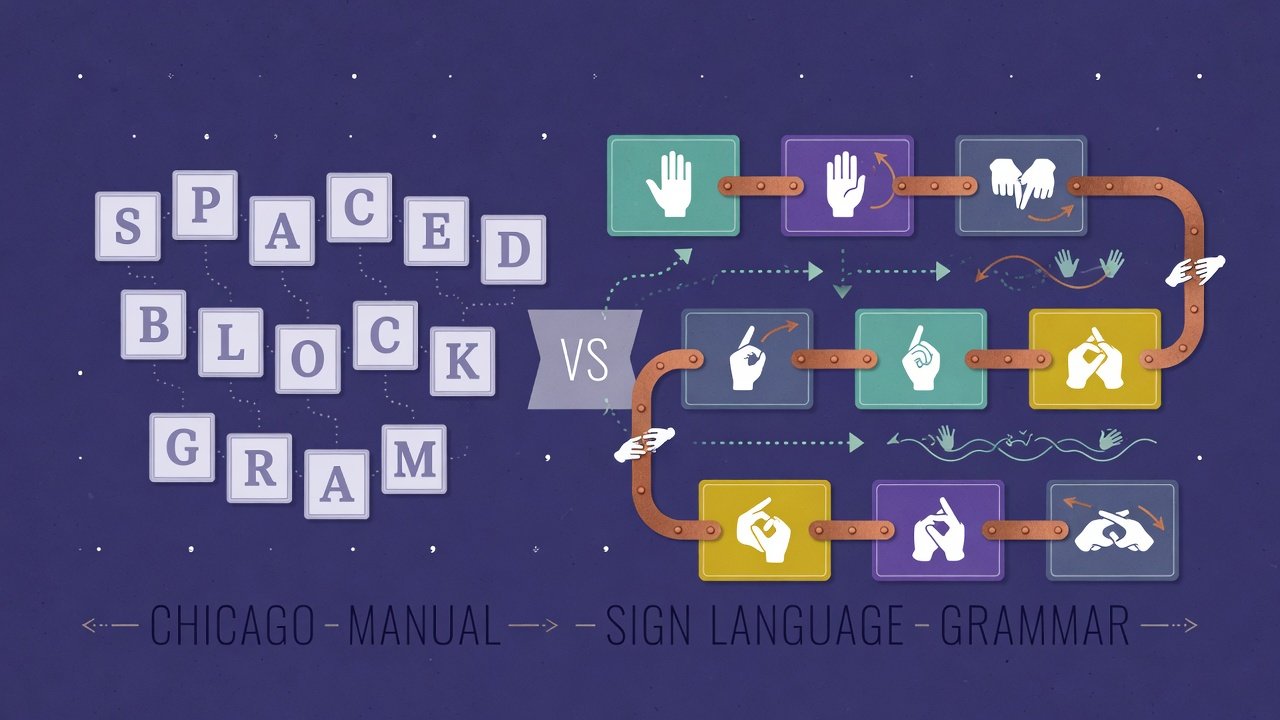
Chicago Manual of Style §11.147 and American Sign Language
A central citation is the Chicago Manual of Style, 16th edition, foreign languages (article / section 11.147). It is used as hard evidence that all-uppercase text is a foreign entity to written English, that there is no correspondence between signs and words of any two languages, and that sign-language grammar differs from English.
Example given for ASL: “A car drove by” → “VEHICLE-DRIVE-BY.” Notice the hyphen. In written Latin / ASL, one rest (space) constitutes a break between signs. In English descriptive text, one rest (space) constitutes joinder between words; two rests or rest-plus-stop breaks the English sentence. Two different rule-sets. Therefore Latin or ASL used without hyphens renders nothing in fact—only an ignorant presumption that all-uppercase text is valid. That is word science.
Applied to a registered company style string such as “COMMONWEALTH OF AUSTRALIA”:
- As Dog-Latin: “Commonwealth. Of. Australia.” — does it even exist as English meaning?
- As correct ASL/Latin signs: “COMMONWEALTH-OF-AUSTRALIA”
There is no all-uppercase text constituted in English grammatical rules; there is also no unhyphenated string of signs in proper Latin/ASL. Foreign private banks and securities registrations of commonwealth-style accounts are then questioned as lawful de jure capacity—only assumed by the illiterate who could not read proper English. Why does a Governor-General “assume” office? Because, it is argued, there is no office in fact—private foreign banking entities may have destroyed real governments via a trick in the text (a “joker” card). Is Dog-Latin the language of the dog subject to its master, man? Is the licence the dog-tag in Dog-Latin—Mr / Miss as military style? Are you legally dead and not yet aware?
Adam and Eve as trust-law warning
The first biblical story is read as a trust-law arrangement: usurper (Vatican frame), house of the debtor (Tree of Knowledge), house of the creditor (Tree of Life)—split title, divide and conquer. God warned Adam to stay from the fruit of the Tree of Knowledge (house of the debtor). Annexing to that fruit—privilege of slavery?—made Adam no longer simply man but account-holder (trustee) of a dead account of Rome. “You will surely die” is read as legal death: loss of equitable title over Eden to the serpent, cast into the sea, re-entry only under licence. He held the ledger—the tomb.
Posting means transferring an account to a ledger; the ledger is the stone that covers a tomb. The holder of the ledger is dead, entombed into the contract—as God warned Adam.
In trust-law, true title splits into legal title and equitable title. Holding legal title without licence does not give rights over equity. If you need a licence to drive “your” car on public land, you no longer hold equitable title; the grantor of the licence holds equity. If government is a company registered with U.S. securities systems, the private federal reserve banking frame is suspected of holding equity in cars, homes, countries, dominion, bodies, oil and minerals—did they take it, or was it given without a fight?
Two birthing certificates and dogged certificates
Two birthing certificates are evidence of split title—debtor or creditor; the choice is yours if you know it exists. You cannot get the “other” certificate of birth unless you know the name and registration date of the Christian account (often on the face of the certificate under your nose). Disturbingly, the certificates themselves may be dogged in Dog-Latin—e.g. “CERTIFICATE OF BIRTH” → “Certificate. Of. Birth.”—nonsensical. The prima facie Christian-name certificate dogged so that, when exposed, only the living man’s ignorance of biblical codes and grammar is left as the reason equity was given. People applied to hold accounts; as good dog-servants, the system obliged and gave legal death. As Eve said, the privilege tastes good—until you miss a payment.
Adam’s loss of equity was masterpiece deception by the serpent. “Thou shalt not worship engraved images” is linked to all-uppercase text as grammatically an engraved image—illustrative hieroglyph of the house of the dead. En-“graved” points to the ledger-slab on a tomb. Corporation is glossed as “dead-speaking.” How can you be assumed living man while holding dead accounts of Rome? The Christian cross is noted as symbolising “died.” By holding any licence you tell the world you are dead, no longer equitable title holder of Eden, legal title holder worshipping the serpent, debtor of the snake. You lost jurisdiction with the first God of living man by holding the dead person and dead accounts of Rome. G-O-D: Grantor Of Dominion—grantor master, grantee slave-servant.
Nomen and cognomen
A nomen is a name—the power of Rome in classical framing; a SURNAME is a cognomen, not a nomen—it is subject to the direction of the nomen. If the Christian name (nomen) is attached to the cognomen (SURNAME), you become servant of Rome and lose directive power. Why does the Queen of England hold no surname? The property of Rome is not her business, in that telling.
Adam was first trustee of the first Grantor. Only when deceived into legal title by accepting the fruit (NOTICE) did he lose equitable hold over dominion. He accepted under his own volition; legal and equitable title cannot be held as one at the same time. Christ is described as offering a remedy inside the dead world: a trustee for the legal Christian account so living man remains director of the serpent within the world of the dead—hence two names, one property of the dead state. Every system must have a remedy, but it requires comprehension of biblical trust-law and of what G-O-D means. Anyone who grants is god of what he grants; the grantee who accepts is indebted—even if the grant was a deception. The Vatican granted the person; the first God of the living granted existence, not death. If you are a person, your god is the second god of death, the serpent. A person is a dead entity, a corporation.
The serpent is now de-facto quasi holder of equitable title over Eden because the true first beneficiary—man—has been evicted by deception, lost at sea, assumed never to return. That is why codes of mass governance hide in grammatical deceptions. Return of the beneficiary would put the benefactor back as debtor-trustee. Power of Rome is only a grammatical deception; the Vatican is servant of man. Man granted legal title over dominion to the Vatican as debtor; the Vatican accepted—then deceived man into becoming legal title holder of the Vatican, turning man from beneficiary into vassal of the vessel: debtor of the debtor.
Annexing living man to dead accounts
The masterpiece was to annex (attach) living man to dead accounts of Rome so Justinian’s authority ran over the account, not the man—yet the man, as assumed holder/trustee, must settle the account’s debts. The Dog-Latin trustee is the legal dead third-party slave of that Roman account.
The Vatican grants the system of mass control by deceit to an empire to administer; it may also resume the system if the empire does not please the grantor—copyright recall ending empires that fail to pay the serpent’s cut. Rome is now often identified with the United States Federal Reserve under City of London direction; it may hold the “holy lance” that divides and conquers—splitting blood and water, creditor and debtor.
The surname as foreign account
If a man assumes that his heritage name “Smith,” appearing as symbolic “SMITH” on paper, is his own property, he has claimed ownership of a foreign Roman debtor account. The SURNAME in Roman all-caps is Rome’s property, not his. He becomes dead account-holder trustee of foreign Rome (federal reserve-style accounts), subject to foreign statutes without compensation—conned into the Justinian deception.
Registration of commonwealth-style entities with U.S. securities systems is said to be public-domain fact—linked to City of London and Rome. Nothing was fully hidden; the mind was programmed not to believe the truth. (The source advises reducing TV indoctrination and learning grammar.)
Power bills, rates, water bills—all “accounts”—are rendered in illustrative all-uppercase Dog-Latin, grammatically declaring foreignness, neither correct English nor correct Latin: debts of a foreign private administrator, property of the usurper. Anything in all caps—name, town, street, state—or two capitals joined without space is presumption, not fact. That is where presumption of law is said to derive. All-uppercase sign language is not written text; it is a picture—the joker in the document (Black’s Law Dictionary, 4th edition, is cited in the source tradition).
Accounting as the art of conferring debt titles
Accounting is called the art (art of cunning) of conferring debt titles upon the unsuspecting. All-uppercase text is a legal title that renders you trustee; if you claim ownership-trusteeship, you must settle the debt.
The greatest deception people refuse to believe: all-uppercase symbolic text is not English, while mixed-case descriptive text is English. Different grammatical rules. If you do not know the difference between English and ancient Latin / ASL rules, you fall for foreign accounts of Rome, City of London, and the Federal Reserve frame—you become citizen of Rome, debtor-trustee of the Vatican, dead legal fiction, ripe for plunder. You are no longer townsman or countryman but foreign “citizen,” trustee to Rome. Even “city” is linked as abbreviation to the City of London square mile.
When rates, power, court, and state “bills” arrive, they are accounts; only when you claim the envelope and the account within do they become your bill—because you agreed to act as account holder of what you assumed was your name or address but was foreign account designation. Accounts are things; things are rendered in sign language, all uppercase.
Terror, police, and who benefits
The source asks who the real terrorists are: militarised police enforcing compliance, courts and officials who will not answer grammatical questions, de-facto corporate governments owned by banks that profit from selling debt—registered to foreign securities systems. Conflict of interest is alleged when governments manufacture debt for bank profit. People who question the system meet a different government than they assumed. Terrorising masses into servitude may work short-term; is it right, and will it last?
If you knew what maritime new-world-order government did to obtain consent, you would not trust media, police, and courts as separate—they maintain grammatical deception to keep minds under Vatican-style control. One-world government under water law of corporations requires fiction; instruments must never exist in fact—you agree to accept fiction so they are never accountable. Ignorance of the law is no defence; the real laws are the rules of the language of the account you hold and the laws of God. If you do not know your God, you may serve a false one.
If you do not know who you are or your real name, you are assumed lost at sea, giving Rome and the Church salvage rights over your estate—but as Christ claimed, only in his name shall you be saved. You have a Christian name for that reason—unless you attach it to foreign accounts of Rome, the all-uppercase “mark of the beast.”
Two state certificates: birth of the SURNAME account (born date) and birth of the Christian-name account (registration date). Choice exists only if you know it exists—house of debtor vs house of creditor.
Warning from the source tradition: discovering bank and Vatican fraud may bring you face to face with extreme corporate greed and people who will go to great lengths—sometimes terror—to uphold compliance. Think carefully before you walk that road of knowledge. This site presents the research for education only.
Summary tables for study
| Living man / English standing | Attached to Dog-Latin accounts |
|---|---|
| Given / Christian name capitalised | ALL-CAPS surname / trade style |
| Equitable title / dominion | Legal title / licence dependency |
| Creditor path / tree of life frame | Debtor path / tree of knowledge frame |
| Land / common law / living | Sea / maritime commerce / dead person |
| First God — Grantor of Dominion | Second god — person / corporation / Rome |
Study contrast — not a prescription; verify yourself
| English descriptive rules | Latin / ASL sign rules (CMS 11.147 tradition) |
|---|---|
| Space joins words | Space breaks signs; hyphen joins signs |
| Two rests / stop ends sentence | One rest stopples between signs |
| Names capitalised, not symbolised | Signs are illustrative / engraved-image style |
| No all-caps proper-noun system | Unhyphenated ALL CAPS = presumption only |
No correspondence between the two languages without agreement
Related study on this site: The Power of Words, Meet Your Straw Man, What Is a “Person”?, A “Person” Has No Body, When You Are Born, Your Living Identity, Dead or Alive, Theatre of Commerce, Driving Is Commerce, Jurisdiction Is the Key, Rebut the Presumption, Your Sovereignty.
Adapted for education from research themes published under “Justinian Deception (Hidden Foreign Text Known as Dog-Latin)” (widely circulated; original research often linked to questions raised in Queensland courts and the justiniandeception tradition, circa 2010–2016). Meaning preserved; wording rewritten and organised for this site. Not legal advice. Verify grammar manuals, dictionaries, and filings yourself.